
Fun with playing around the TI 5121 DAC.
modes
pp 6:
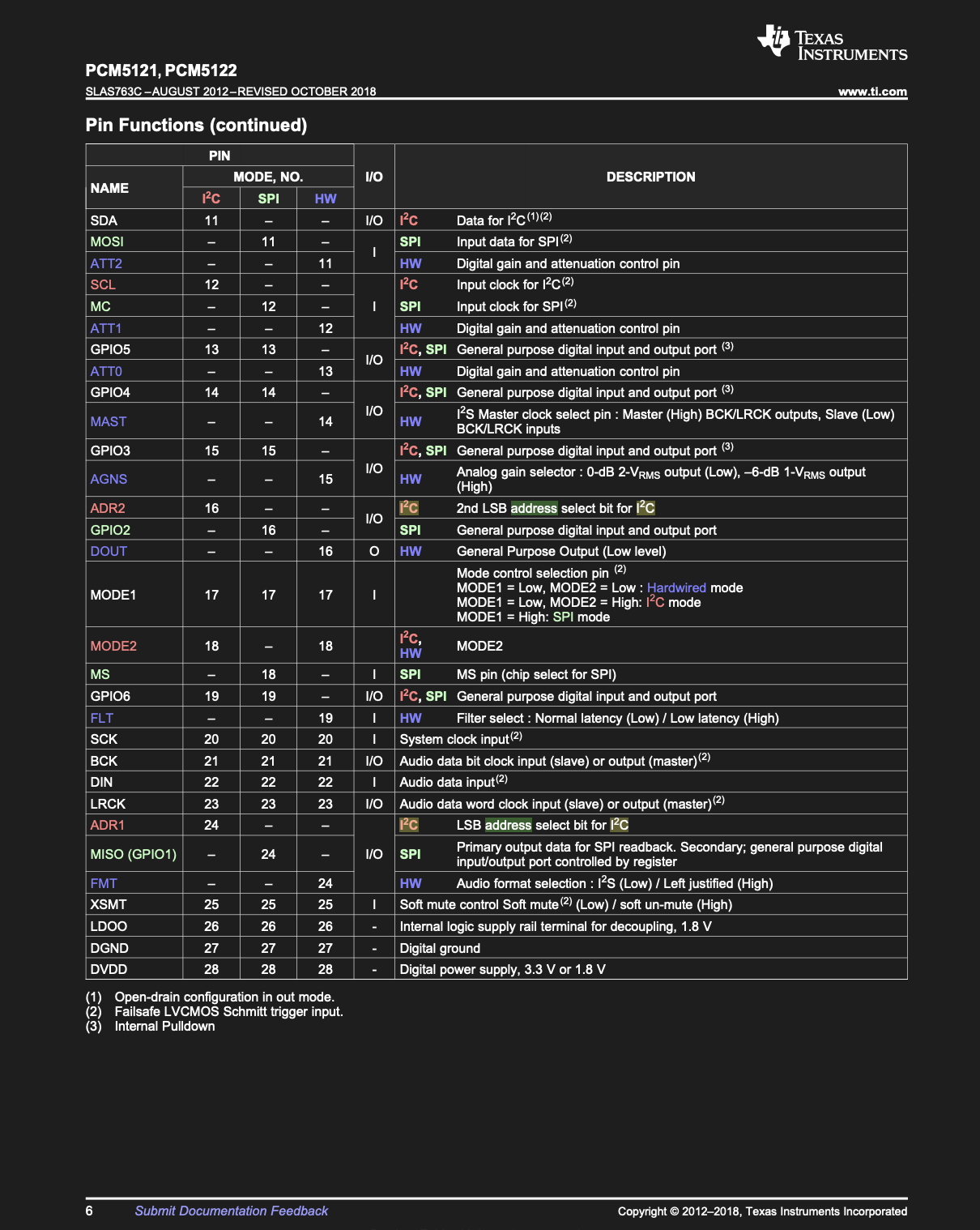
i2c interface
pp 55:
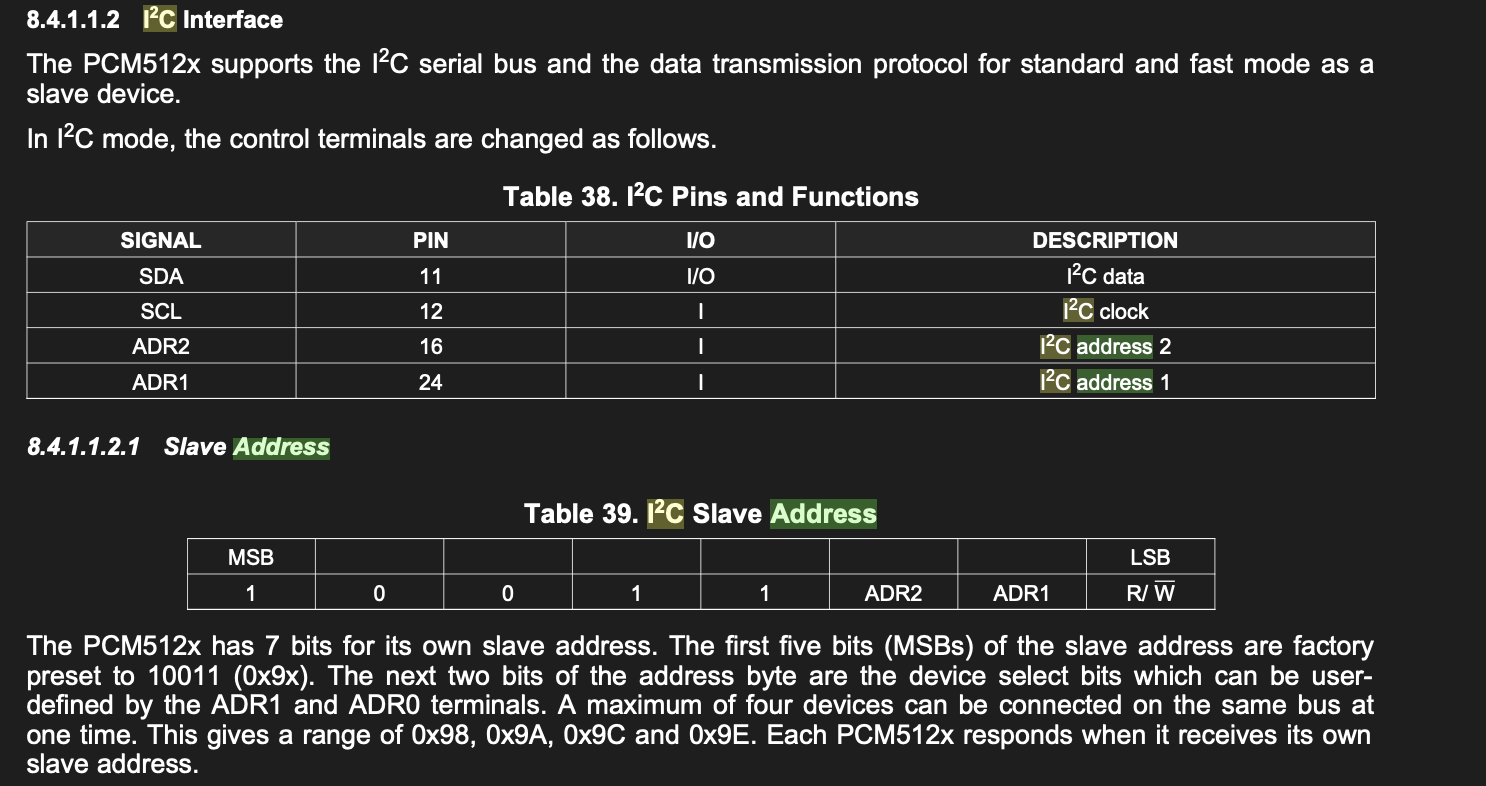
Write: 0x98 - 10011000 Read: 0x99 - 10011001
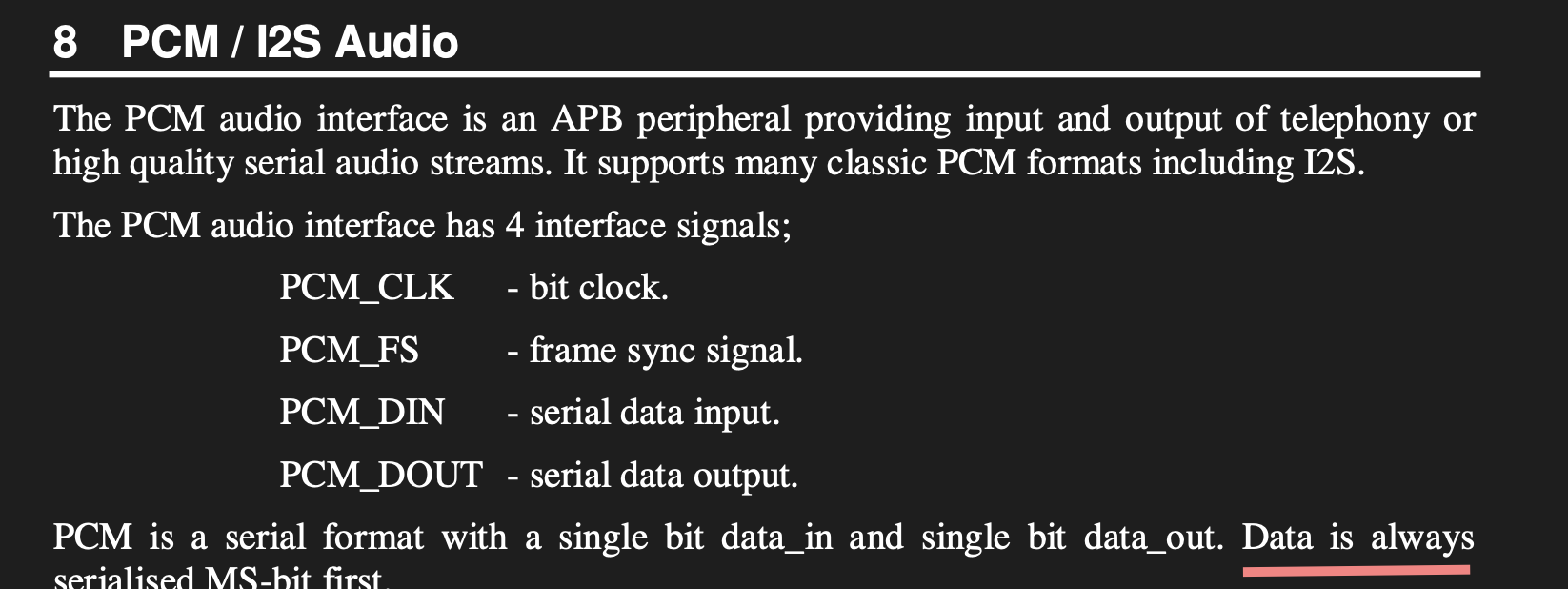
i2s interface on BCM
page 119
but how do I set the master clock?
Heh. Its not documented. Go figure. Fortunately, https://firmanhp.com/assets/20241005-id-raspi-bare-metal-rust/pdf/BCM2837-ARM-Peripherals-Revised-V2-1.pdf seems to tell us what to do:
There are two PCM/I2S clock control registers.
CM_PCM_CTRL @ 0x7E101098
- Bit 5 = Emergency Stop; should be 0; debugging only
- Bit 4 = Clock Enable
- Bits 3:0 = Clock Source
OSC (SRC=0b0001) is cool and allegedly good, but it runs on 19.2 which is less than crispy crispy 48khz so we are going to use PLLD (SRC=0b0110) which runs at a cheeky 500MHz nominal.
CM_PCM_DIV @ 0x7E10109C
The divider is split between an integer divider and a fractional (mashing) divider. The mashing dividers are build such that clock artifacts should be pushed out of the audio frequency domain.
- Bits 31:24 = you have to put the value 0x5A here
- Bits 23:12 = the integer divider.
- Bits 11:0 = the mashing divider.
See page 105 in BCM2835-Peripherals for MASH math.
DWIM (Do What I Mean) for the inpatient and numerically inept
32 bits per slot and two channels (64 BCK cycle per stereo frame), crispy audio at 48000Hz breaks down as:
| Field | repr | Value |
|---|---|---|
| SRC | 0110 | 6 |
| MASH | 01 | 1 |
| DIVI | 000010100010 | 162 |
| DIVF | 110000101011 | 3115 |
The maths is as follows:
\begin{equation} f_{\text{bck}} = \frac{f_{\text{source}}}{\text{DIVI} + \frac{\text{DIVF}}{4096}} \end{equation}
And so since we are using a 500MHz clock plugging in the above math we get a nice:
\begin{equation} f_{\text{bck}} \approx 3.072 \text{MHz} \end{equation}
Now, remember, each of our frames has 64 BCK cycle per stereo frame, so this gives \(\frac{3.072}{64} = 0.048 \text{Mhz} = 48 \text{kHZ}\) which is sweet.
DWIM for folks like me who have been afflicted with a utter lack of attention span
CM_PCMCTL: 0x5A000216CM_PCMDIV: 0x5A0A2C2B
synth notes
Music is math.
\begin{equation} x\qty(t) = \sin \qty(2\pi ft) \end{equation}
But computers only do discrete math.
\begin{equation} x[n] = \sin \qty(2\pi f \frac{n}{f_{s}}) \end{equation}
where \(f_{s}\) is the same rate and \(n\) is the sample ID.
aliasing
Mathematically speaking, the above is all fine and good but you’ll notice a persnickety thing about mathematics. The nyquest limit, which is half the sample rate, is the maximum rate of the signal that can be represented by sampling without aliasing. What do I mean by aliasing? Consider \(f_{s} = 48000\), \(f=48000\):
\begin{equation} x[n] = \sin \qty(2\pi 48000 \frac{n}{48000}) = \sin \qty(2\pi n) = 0 \end{equation}
and so, no matter what your choice of \(n\) is, the signal will always be zero. This is rather cheeky.