line
All points of the form \(x = \theta x_{1} + \qty(1-\theta) x_{2}\), with \(\theta \in \mathbb{R}\) is a “line through \(x_1\), \(x_2\)”.
affine set
For set \(G\), for all two points \(x_1, x_2 \in G\), all points lying on the line \(x_1, x_2 \in G\). For instance, the solution set of a set of linear equations \(\qty {x \mid A x = b}\).
convex set
line segment
all points form \(x = \theta x_{1} + \qty(1-\theta)x_{2}\), with \(0 \leq \theta \leq 1\).
convex combination
A convex combination of points \(x_1 … x_{k}\) has
\begin{equation} x = \theta_{1} x_1 + \theta_{2} x_{2} + \dots \theta_{k} x_{k} \end{equation}
with \(\sum_{j}^{} \theta_{j} = 1\), \(\forall \theta_{j} \geq 0\).
convex hull
set of all convex combination of points in \(S\)
\begin{equation} \qty {\theta_{1} x_1 + \dots + \theta_{k}x_{k} \mid x_{i} \in C, \theta_{i} \geq 0, i = 1 \dots k, \sum_{j}^{}\theta_{j} = 1} \end{equation}
convex cone
Conic combination any combination of the form
\begin{equation} x = \theta_{1} x_{1} + \theta_{2} x_{2} \end{equation}
with \(\forall \theta_{j} \geq 0\).
More generally a combination \(\theta_{1} x_1 + … + \theta_{n} x_{n}\) for \(\forall \theta_{j} \geq 0\) is called a “conic combination”.
convex cone or a conic hull is the set of all conic combinations of points in \(C\):
\begin{equation} \qty {\theta_{1} x_1 + \dots + \theta_{k}x_{k} \mid x_{i} \in C, \theta_{i} \geq 0, i = 1 \dots k} \end{equation}
properties of convex cone
hyperplane
Set of the form:
\begin{equation} \qty {x \mid a^{T} x = b}, a \neq 0 \end{equation}
“the solution set f a single linear equation”. If \(b\) were \(0\), we can think about it as “all the points that are orthogonal to \(a\).
halfspace
\begin{equation} \qty {x \mid a^{T}x \leq b}, a \neq 0 \end{equation}
Euclidian ball
Set of points with \(L_2\) norm smaller than \(r\):
\begin{equation} B\qty(x_{c}, r) = \qty {x \mid \norm{x -x_{c}}_{2} \leq r} = \qty {x_{c} + ru \mid \norm{u}_{2} \leq 1} \end{equation}
ellipsoid
For Symmetric PSD \(P \in S_{++}^{n}\):
\begin{equation} \qty {x \mid \qty(x- x_{c})^{T} P^{-1} \qty(x - x_{c}) \leq 1} \end{equation}
also written as:
\begin{equation} \qty {x_{c} + A u \mid \norm{u}_{2} \leq 1} \end{equation}
for nonsigular \(A\).
norm
norm ball
\begin{equation} \qty {x \mid \norm{x - x_{c}} \leq r} \end{equation}
norm cone
\begin{equation} \qty {\qty(x,t) \mid \norm{x} \leq t} \end{equation}
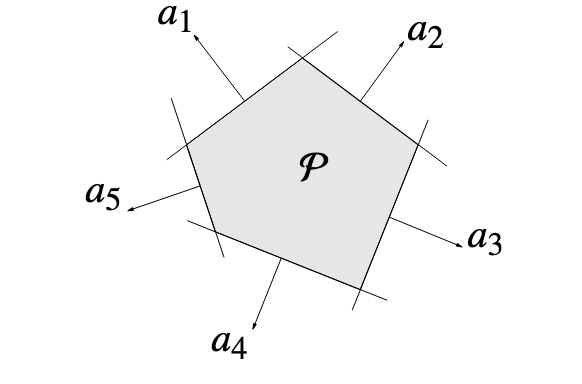
polyhedron
\begin{equation} \qty {x \mid Ax \preceq b, Cx = d} \end{equation}
where \(\preceq\) is “elementwise less-than”. You can think of each \(a_{j}^{T}\) as a row of \(A\).
PSD cones
symmetric matrices
positive semidefinite matrices (geometry)
\begin{equation} S_{+}^{n} = \qty {X \in S^{n} \mid X \succeq 0} \end{equation}
this is a convex cone.
positive definite (symmetric) metricies (geometry)
\begin{equation} S^{n}_{++} = \qty {X \in S^{n} \mid X \succ 0} \end{equation}
proper cone
a convex cone \(K \subseteq R^{n}\) is a proper cone if:
- \(K\) is closed
- \(K\) is solid (non-empty interior)
- \(K\) is pointed (contains no line) — \(v\) and \(-v\) can’t both have a line
- \(K\) is non-trivial (not empty)
generalized inequality
For proper cone \(K\):
\begin{equation} x \preceq_{K} y \Leftrightarrow y - x \in K \end{equation}
\begin{equation} x \prec_{k} y \Leftrightarrow y - x \in \text{interior} K \end{equation}
Triangle inequality holds:
\begin{equation} x \preceq_{k} y, u \preceq_{k} v \implies x+u \preceq_{k} y + v \end{equation}
This is not well ordered.