
AP Phys C Mech Index
Last edited: August 8, 2025AP Phys C Mech is an examination held by the CollegeBoard in mechanics.
Things to Study
- Permittivity of free space
- Impulse
- Springs! In general. Perhaps review old notes.
- How to be faster?
ap physi
Last edited: August 8, 2025AP Statistics Index
Last edited: August 8, 2025AP Statistics is an examination by the CollegeBoard.
See also crap to remember for AP Stats
Non-Focus Mistakes
- file:///Users/houliu/Documents/School Work/The Bible/APStats/APStats5Steps.pdf
- file:///Users/houliu/Documents/School Work/The Bible/APStats/APStats5Steps.pdf
- file:///Users/houliu/Documents/School Work/The Bible/APStats/APStats5Steps.pdf
- Interpretation of regression outputs
Backlog
- Chi-square
- file:///Users/houliu/Documents/School Work/The Bible/APStats/APStats5Steps.pdf
- file:///Users/houliu/Documents/School Work/The Bible/APStats/APStats5Steps.pdf
Notes
applying eigenspace
Last edited: August 8, 2025Show that:
\begin{equation} \dv t e^{tA} = e^{tA}A \end{equation}
We can apply the result we shown in eigenvalue:
\begin{equation} \dv t \qty(e^{tA}) = \dv t \qty(I + \sum_{k=1}^{\infty} \frac{t^{k}}{k!}A^{k}) = \qty(\sum_{k=1}^{\infty }\frac{1}{k!}kt^{k-1}A^{k-1})A \end{equation}
We do this separation because \(k=0\) would’t make sense to raise \(A\) (\(k-1=-1\)) to as we are unsure about the invertability of \(A\). Obviously \(\frac{1}{k!}k = \frac{1}{(k-1)!}\). Therefore, we can shift our index back yet again:
\begin{equation} \qty(\sum_{k=1}^{\infty }\frac{1}{k!}kt^{k-1}A^{k-1})A = \qty(\sum_{j=0}^{\infty }\frac{1}{j!}t^{j}A^{j})A \end{equation}
approximate inference
Last edited: August 8, 2025Direct Sampling
Direct Sampling is an approximate inference method where we pull samples from the given joint probability distribution.
Example
Suppose we are interested in:
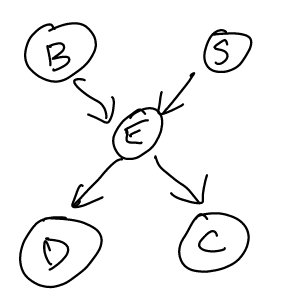
where we dare \(P(B^{1}|D^{1},C^{1})\).
Step 1: sort
We obtain a topological sort of this network:
\begin{equation} B, S, E, D, C \end{equation}
Step 2: sample from \(B,S\)
- We sample \(B\). We sampled that \(B=1\) today.
- We sample \(S\). We sampled that \(S=0\) today.
Step 3: sample from \(E\)
- We sample \(E\) GIVEN what we already sampled, that \(B=1, S=0\), we sampled that that \(E = 1\)
Step 4: sample from \(D, C\)
- We sample \(D\) given that \(E=1\) as we sampled.
- We sample \(C\) given that \(E=1\) as we sampled.
Repeat
Repeat steps 2-4