Authoritarianism
Last edited: August 8, 2025autism
Last edited: August 8, 2025autism is a spectrum disorder that are caused by both environmental and genetic factors.
Key Question: how can different chromatin regulators lead to the same set of symptoms named “autism”.
autism gene signature
The gene signature of autism can be measured in clean and quantitative assays.
Automatic Differentiation
Last edited: August 8, 2025Forward Accumulation
First, make a computation graph.
Consider \(\ln (ab + \max (a,2))\)
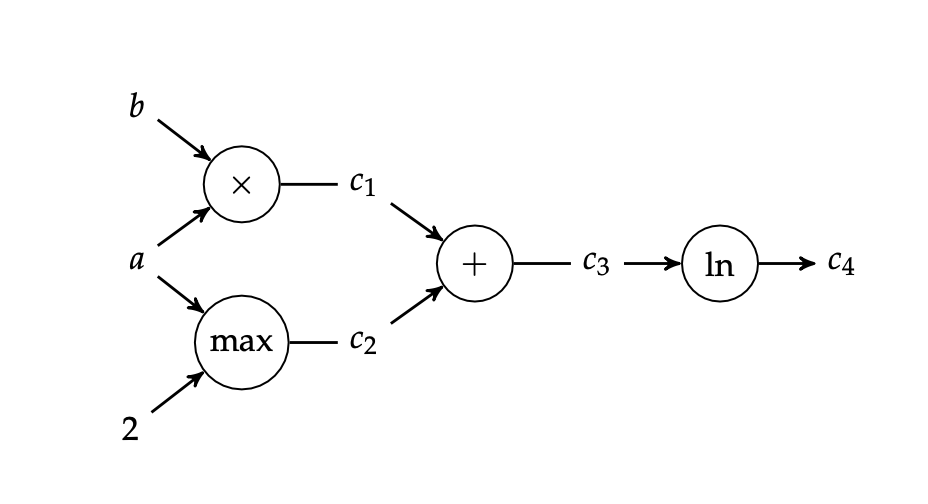
Say we want \(\pdv{f}{a}(3,2)\).
Let’s begin by tracking, left to right, both the value of each node and its derivative.
Layer 1:
- \(b = 2, \pdv{b}{a} = 0\)
- \(a = 3, \pdv{a}{a} = 1\)
Layer 2:
- \(c_1 = a\times b = 6, \pdv{c_1}{a} = b\pdv{a}{a} + a \pdv{a}{b} = 2\)
and so on; until we get to \(c_4\)
autonomous ODEs
Last edited: August 8, 2025an First Order ODE is “autonomous” when:
\begin{equation} y’ = f(y) \end{equation}
for some \(f\) of one variables. Meaning, it only depends on the independent variable \(t\) through the use of \(y(t)\) in context.
This is a special class of seperable diffequ.
autonomous ODEs level off at stationary curves
for autonomous ODEs can never level off at non-stationary points. Otherwise, that would be a stationary point.
See stability (ODEs)
time-invariant expressions
For forms by which:
axiomatic semantics
Last edited: August 8, 2025Pre-conditions and post-conditions for specify logical formula; this is the basis of verification systems.