Diagonal Matrix
Last edited: August 8, 2025The diagonal of a square matrix consists of entries from the upper-left to the bottom-right
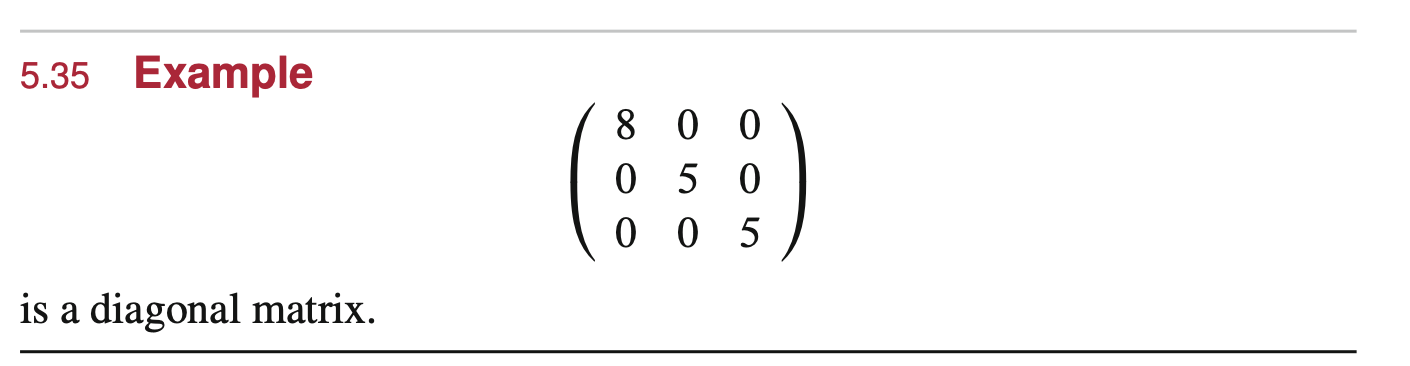
Furthermore, because eigenvalues of a map are the entries of the diagonal of its upper-triangular matrix, and this is technically an upper-triangular matrix, the entries on the diagonal are exactly the eigenvalues of the Linear Map.
properties of diagonal matrices
Suppose \(V\) is finite-dimensional, and \(T \in \mathcal{L}(V)\); and let \(\lambda_{1}, … \lambda_{m}\) be distinct eigenvalues of \(T\). Then, the following are equivalent:
diagonalization argument
Last edited: August 8, 2025Dialogue
Last edited: August 8, 2025A human Dialogue is a human to human interaction.
turn
each contributino to a conversation is called a “turn”, which contains a sentence, multiple sentences, or a single word
turn-taking
- when to take the floor
- who takes the floor
- what happens during interruptions?
barge-in
barge-in is the property to allow the user to interrupt the system
end-pointing
deciding when a human has stopped talking, compute, etc.
speech-act
each turn is actually an “action” performed by the user
Dialogue State Architecture
Last edited: August 8, 2025Dialogue State Architecture uses dialogue acts instead of simple frame filling to perform generation; used currently more in research.
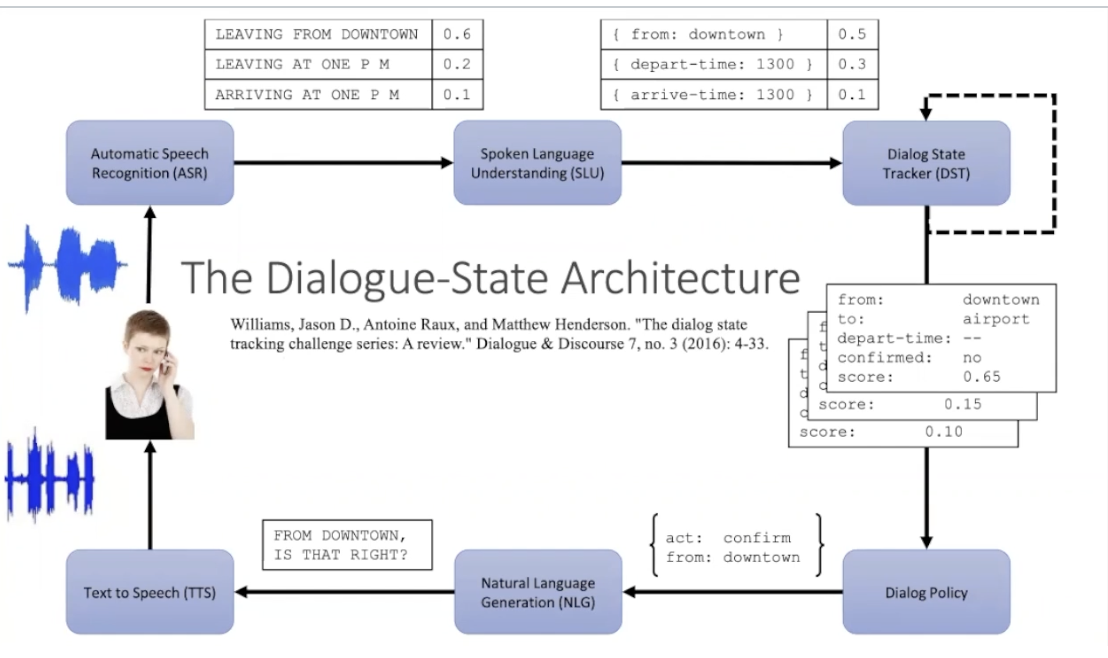
- NLU: slot fillers to extract user’s utterance, using ML
- Dialogue State Tracker: maintains current state of dialogue
- Dialogue policy: decides what to do next (think GUS’ policy: ask, fill, respond)—but nowaday we have more complex dynamics
- NLG: respond
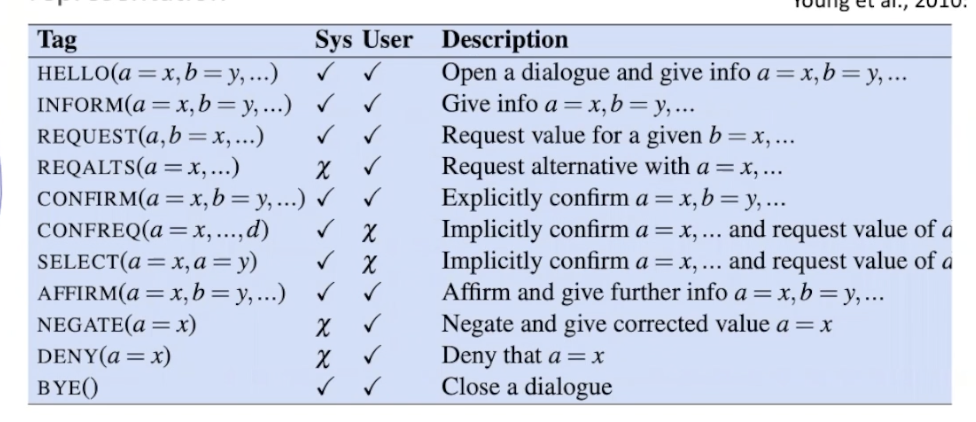
dialogue acts
dialogue acts combines speech-acts with underlying states
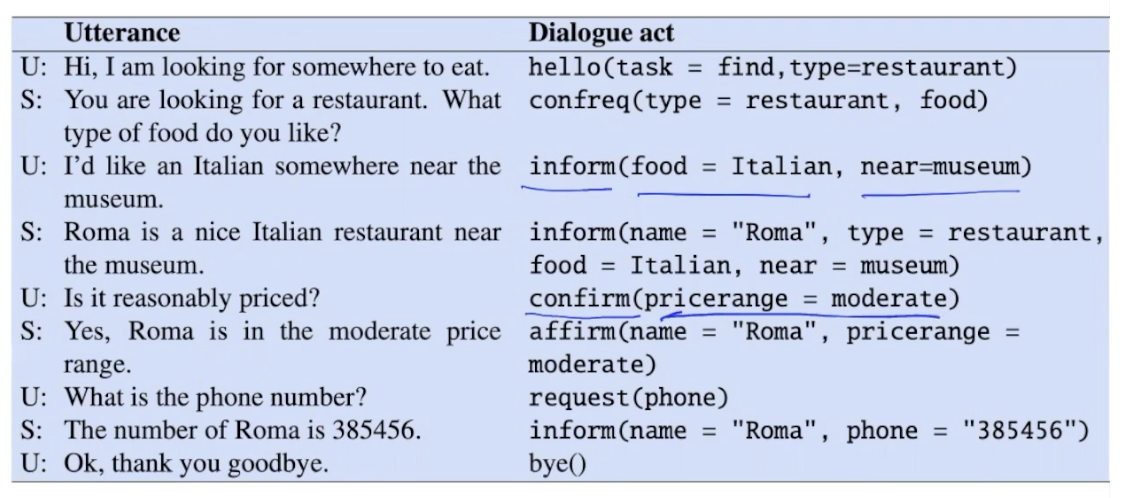
slot filing
we typically do this with BIO Tagging with a BERT just like NER Tagging, but we tag for frame slots.