
Gauss' Law
Last edited: August 8, 2025The Gauss’ Law is a principle of electric flux of uniformly distributed electric field along a surface: that, the electric flux through a closed surface is the sum of the electric charge enclosed divided by the permittivity of free space.
That is:
\begin{equation} \oint E \cdot dA = \frac{\sum Q}{\epsilon_{0}} \end{equation}
somewhat motivating Gauss’ Law
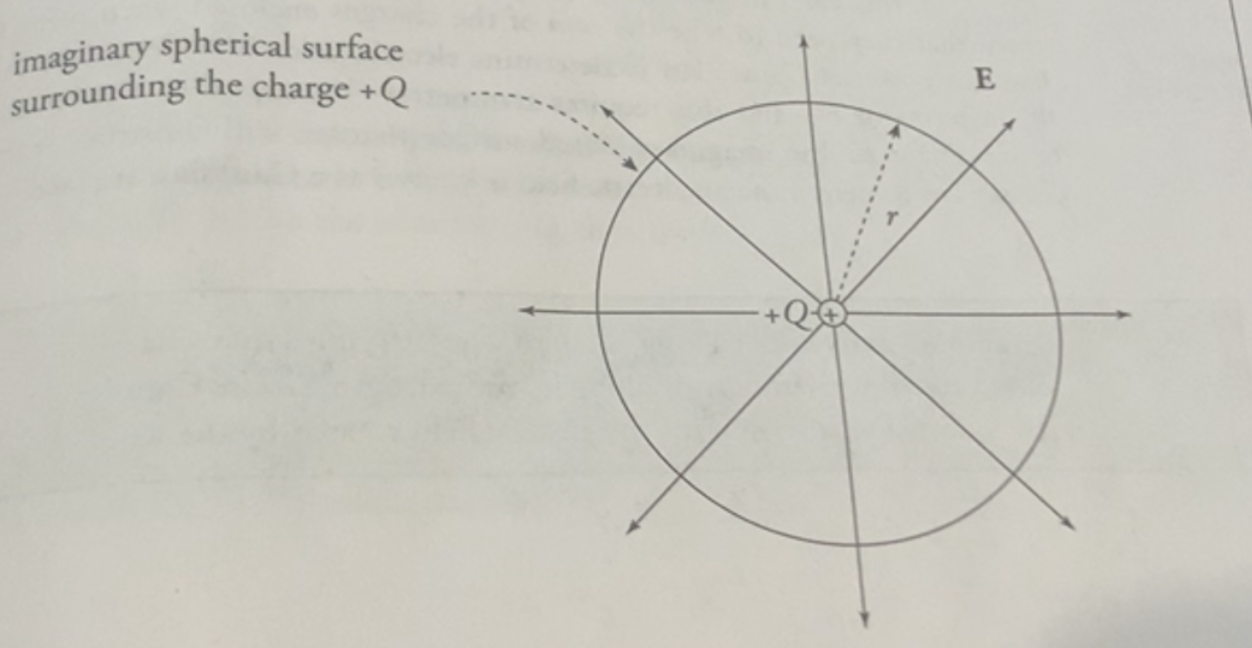
Consider a sphere with uniformly distributed charge on its surface. It has surface area \(4 \pi r^{2}\). Given the expression of electric flux and the fact that the origin change is in the center, and the test change is evenly distributed (i.e. \(E\) is held constant):
Gaussian
Last edited: August 8, 2025The Gaussian, in general, gives:
\begin{equation} e^{-\frac{ax^{2}}{2}} \end{equation}
which is a Bell-Shaped curve. It’s pretty darn important
solving heat equation without boundary
for general expression:
\begin{equation} \pdv{U}{t} = \alpha \pdv[2]{U}{x} \end{equation}
\begin{equation} U(t,x) = \frac{1}{\sqrt{4\pi \alpha t}}\int_{\mathbb{R}} f(y) e^{-\frac{(x-y)^{2}}{4\alpha t}} \dd{y} \end{equation}
where,
\begin{equation} \hat{U}(t,\lambda) = \hat{f}(\lambda)e^{-\alpha t \lambda^{2}} \end{equation}
\begin{equation} \hat{U}(t,\lambda) = \hat{f}(\lambda)e^{-\lambda^{2}(t)} \end{equation}
Heat Equation and Gaussian
\begin{equation} H(t,x) = \frac{1}{\sqrt{2\pi} t}e^{-\frac{x^{2}}{2t}} \end{equation}
You will note that \(H\) does satisfy the heat equation:
Gaussian elimination
Last edited: August 8, 2025The point of Gaussian elimination is to solve/identiy-ify a linear equation. Take, if you have a matrix expression:
\begin{equation} Ax = b \end{equation}
We can apply \(A^{-1}\) to both side, we then have:
\begin{equation} A^{-1}Ax = A^{-1} b \end{equation}
Applying the definition of the identity:
\begin{equation} Ix = A^{-1}b \end{equation}
Therefore, to solve for some \(A^{-1}\), which would yield \(x\).
GDB
Last edited: August 8, 2025GDB is gnu’s very own debugger
b mainorb 72(set breakpoint onmainfunction or line72)r args(run with args)p thingnameorp 3+5(print a variable or return value)p/tprint as binaryp/xprint as hex
info(get args, locals)nscontinuenext, step, continue
int test;
short lsb = 0xff;
test |= lsb

printf("%d\n",lsb);
int test;
gear
Last edited: August 8, 2025Here’s a list of gears that I like and stuff that I use.
clothing
t-shirt
MUJI Washed Heavy Weight Crew Neck
If you ever have the pleasure of buying these in China, you should. It’s cheaper there. This is a white T-Shirt, its 100% cotton, its heavy, you can wipe your glasses with it, why not?
shorts
Amazon Essential Inseam Drawstring
They are like very basic shorts; they are a nice quality, don’t seem to break, and is drawstring instead of rubber band which makes them nice to adjust.