
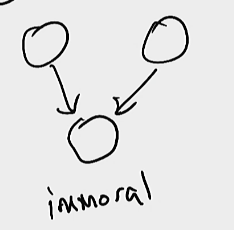
immoral v-structure
Last edited: August 8, 2025v-structure whose parents are unconnected are immoral
This is immoral:
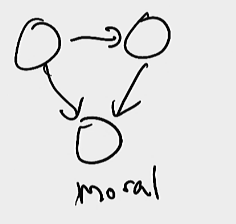
This is moral
Immunogen Design
Last edited: August 8, 2025Using a bunch of signals to create a 3d representation of the system
features
- cyro-EM
- x-ray
- tomo
- glynomics/libidomics
- genetics
studying large-scale viron behavior
Misc. Discoveries bydoing a bunch of MD
- proteins of specific virons “breath”: oning and closing an entire backbone group; this is not yet quantified in physical modeling
- when its open, the “breathing open” motion causes the virus to be vunerable
- *we don’t *
- “we are so biased by what we can see experimentally”
Immunogen Design
Last edited: August 8, 2025Using a bunch of signals to create a 3d representation of the system
features
- cyro-EM
- x-ray
- tomo
- glynomics/libidomics
- genetics
studying large-scale viron surface protein behavior using MD
“we are so biased by what we can see experimentally, so do MD”
“breathing” motion
- proteins of specific virons “breath”: oning and closing an entire backbone group; this is not yet quantified in physical modeling
- when its open, the “breathing open” motion causes the virus to be vunerable
- so some antibodies jam into the open position
“head tilting” motion
- when its tilted, there is an epitope that becomes exposed
- this is a site that’s possible for introduction of what’s needed
overall architecture
- use conventional MD
- discover regions of instability (see above for examples) for possible binding surfaces
- bam inhibition!
maybe at some point run a cyro-EM to experimentally run some
Imperialism
Last edited: August 8, 2025Imperialism: a policy of extending a country’s power and influence though diplomacy or military force.
- Colonies
- Protectorate — nations has own government legally controlled by outside power
- Sphere of influence
U.S. Imperialism, why?
- “Desire for Military strength”: for a nation to be an international player, you have to have a strong navy
- “Thirst for new markets”: if we continue to expand, we will have more economic power
- “Belief in supernatural superiority”: trust that own culture is better
Alaska — “Seward’s Ice Box”, purchased from czarist Russia.
Importance Sampling
Last edited: August 8, 2025Key insight: suppose you have some fairly rare event and you want the likelihood of it. We can do this by drawing normal samples and reweighing them.
Suppose we want \(p_{\text{fail}}\); and we have \(q\) the proposal distribution and \(p\) the nominal distribution:
\(\tau \sim q\qty(\cdot)\), \(p_{\text{fail}} = \int 1 \qty {\tau \not\in \psi} p\qty(\tau) \dd{\tau }\)
What if we define a weird \(1\) such that:
\begin{equation} 1 = \frac{q\qty(\tau)}{q\qty(\tau)} \end{equation}