LRTDP
Last edited: August 8, 2025Real-Time Dynamic Programming
RTDP is a asynchronous value iteration scheme. Each RTDP trial is a result of:
\begin{equation} V(s) = \min_{ia \in A(s)} c(a,s) + \sum_{s’ \in S}^{} P_{a}(s’|s)V(s) \end{equation}
the algorithm halts when the residuals are sufficiently small.
Labeled RTDP
We want to label converged states so we don’t need to keep investigate it:
a state is solved if:
- state has less then \(\epsilon\)
- all reachable states given \(s’\) from this state has residual lower than \(\epsilon\)
Labelled RTDP
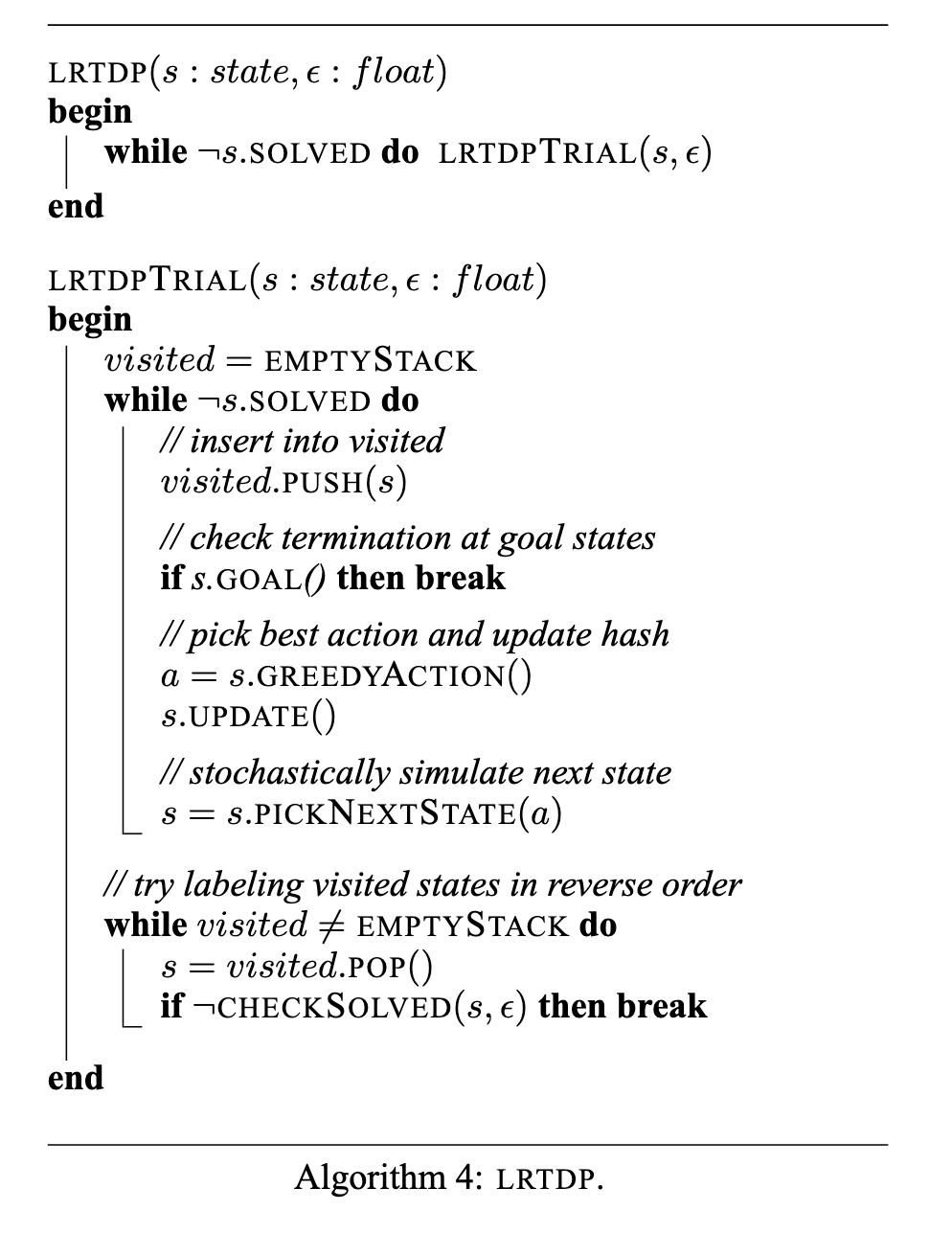
We stochastically simulate one step forward, and until a state we haven’t marked as “solved” is met, then we simulate forward and value iterate
LU-Factorization
Last edited: August 8, 2025Elimination Matricies can be used to derive a LU factorization:
First, this gives an upper triangular matrix
\begin{equation} U = M_{n-1, n-1} \dots M_{22} M_{11} A \end{equation}
We can also create the inverses of each of these:
\begin{equation} A = L_{11} L_{22} \dots L_{n-1,n-1} \cdot M_{n-1,n-1} \dots M_{22} \cdot M_{11} \cdot A \end{equation}
The first half \(L_{j}\) composes a lower triangular matrix; the second half \(M_{j}\) which composes a upper triangular matrix.
LucCage
Last edited: August 8, 2025LucCage is a platform as a biosensor: a case whose binding domain could be changed to fit specific applications
Luz 2021
Last edited: August 8, 2025DOI: 10.1101/2021.03.24.21254263
One-Liner
Review paper presenting the \(ADReSS_o\) challenge and current baselines for three tasks
Notes
Three tasks + state of the art:
- Classification of AD: accuracy \(78.87\%\)
- Prediction of MMSE score: RMSE \(5.28\)
- Prediction of cognitive decline: accuracy \(68.75\%\)
Task 1
AD classification baseline established by decision tree with late fusion
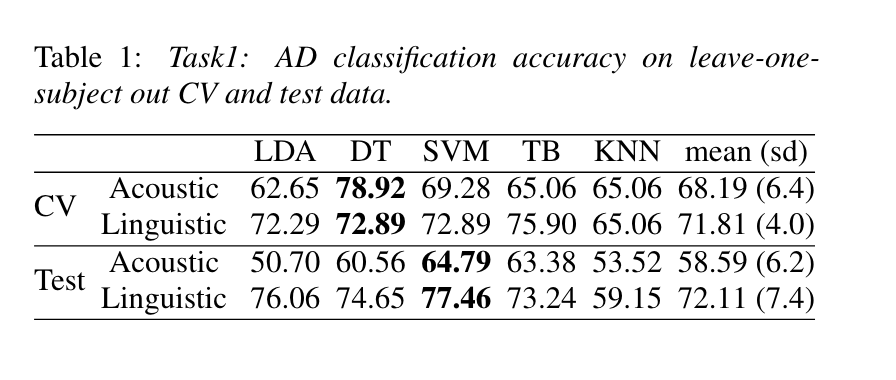
(LOOCV and test)
Task 2
MMSE score prediction baseline established by grid search on parameters.
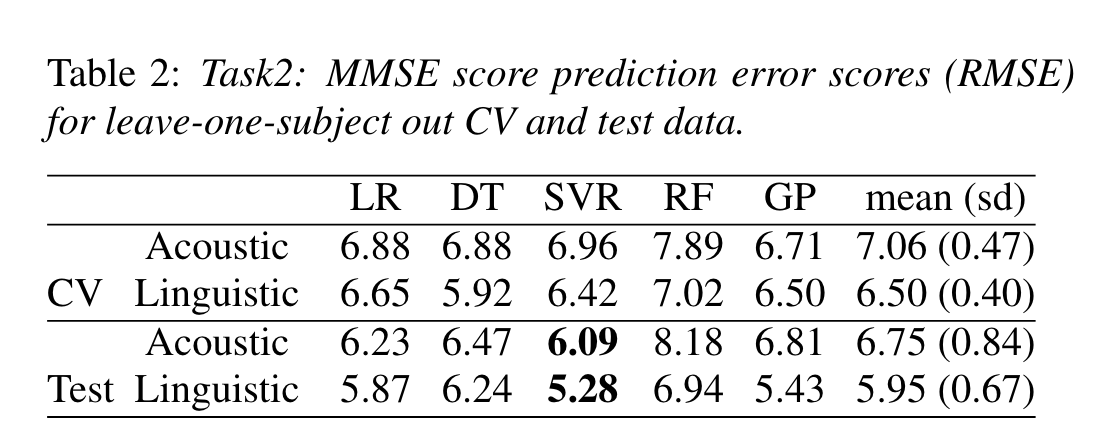
SVR did best on both counts; results from either model are averaged for prediction.
Lyrics: Ping
Last edited: August 8, 2025Seed: walking, loving
Walking
Skipping
Shoes
Road
Running
Forward
Speed
Plane
Travel
Unique
Cold
House
Loving
Cuddling
Kissing
Holding
Together
Staring
Longing
Establish
Spending time
Waving
Welling
Walking together, staring forward longing you
Loving together, skipping forward, a cold house
Cuddling down the avenue, spending time there, Waving by
Establish what it’s like,