qubit
Last edited: August 8, 2025A qubit is a two-layer quantum theory system.
A classical bit is something that can be set between two values, a qubit between a much higher dimension.
Questions for Omer
Last edited: August 8, 2025Week 9
- isn’t \(P^{\text{SAT}}\) just \(\text{SAT}\) with more steps? i.e., because an “oracle” for \(\text{SAT}\) is just a system that checks SAT, and we know that can be done in P no it isn’t because checking requires a witness
- can we use CLIQUE in pset
Week 8
- ask Omer to go over subset sum
Week 7
- so in NP, “nondeterministically guess” happens in order-1 time for all possible choices?
Week 6
- interpreter arguments: why is that changing \(K(x)\) up to a constant? i.e. for instance doesn’t the choice of \(K_{p}(x)\) matter?
- Godel’s consistency: why does the
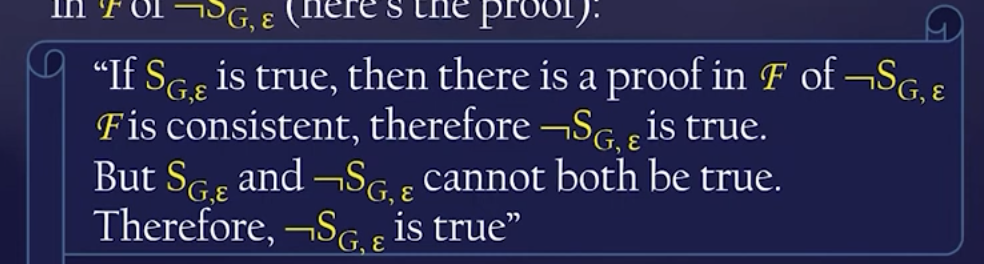
imply that \(\neg S_{G,\varepsilon}\) is true?
quotient group
Last edited: August 8, 2025a quotient group is a group which is the product of mapping things out.
subgroups
The set of integers \(\mathbb{Z}\) is obviously a group. You can show it to yourself that multiples of any number in the group is a subgroup of that group.
For instance:
\(3 \mathbb{Z}\), the set \(\{\dots -6, -3, 0, 3, 6, \dots\}\) is a subgroup
actual quotient groups
We can use the subgroup above to mask out a group. The resulting product is NOT a subgroup, but its a new group with individual elements being subsets of our original group.
quotient map
Last edited: August 8, 2025The quotient map \(\pi\) is the Linear Map \(V \to V / U\) such that:
\begin{equation} \pi(v) = v+U \end{equation}
for \(v \in V\).
I.e.: the quotient map is affine subsetification map given a vector.
quotient operator
Last edited: August 8, 2025Suppose \(T \in \mathcal{L}(V)\), and \(U \subset V\), an invariant subspace under \(T\). Then:
\begin{equation} (T / U)(v+U) = Tv+U, \forall v \in V \end{equation}
where \(T / U \in \mathcal{L}(V / U)\)
“if you can operator on \(V\), you can operator on \(V / U\) in the same way.” Yes I just verbed operator.
quotient operator is well-defined
Why is this not possible for any subspace of \(V\)? This is because we need \(T\) to preserve the exact structure of the subspace we are quotienting out by; otherwise our affine subset maybe squished to various unexpected places. The technical way to show that this is well-defined leverages the property of two affine subsets being equal: