scalar multiplication
Last edited: August 8, 2025Scalar multiplication is the process of multiplying a scalar to an element in a set.
constituents
- A set \(V\)
- Some \(\lambda \in \mathbb{F}\)
- Each \(v \in V\)
requirements
scalar multiplication is defined by a function that results in \(\lambda v \in V\) (maps back to the space!) to each \(\lambda \in \mathbb{F}\) and each \(v \in V\).
additional information
scheduling
Last edited: August 8, 2025scheduling is the tool to figure out which thread can run. Because threads exist in different thread states:
- running
- blockde - waiting for an event like disk, network, etc.
- ready - able to run, but not on CPU yet
a scheduler needs to do the task of ordering ready threads to run, moving running threads to ready when it has ran for enough time. Possible pathways:
- ready => running
- blocked => running
- blocked => ready => running
You can’t go from ready to blocked because you have to do something to know you are blocked.
second moment of area
Last edited: August 8, 2025The second moment of area is a value which—given an origin—describes how point masses are distributed around that origin. (i.e. a number for how point masses are distributed). It is in units \(m^{4}\).
Take, for instance, the following picture:
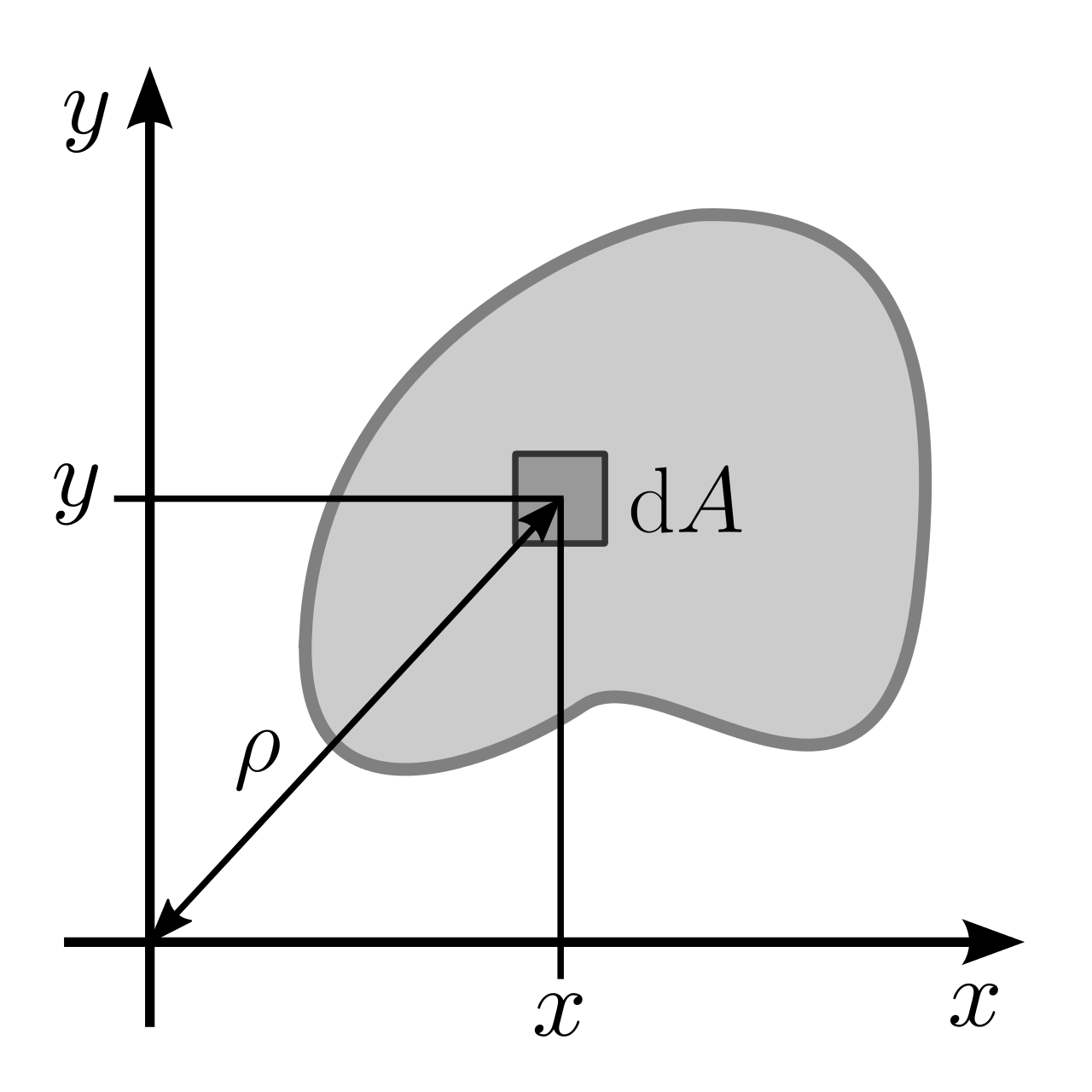
We have defined an origin at \((0,0)\) of the figure above. Furthermore, we have some \(\rho_{i}\) which is the distance from that origin to each of the infinitesimal areas \(\dd{A}\).
Then, the second moment of area is defined as:
second order differential equation
Last edited: August 8, 2025the trick
Here is a pretty ubiquitous trick to solve differential equations of the second order differential equations. It is used to change a second order differential equation to a First-Order Differential Equations.
If you have a differential equation of the shape:
\begin{equation} x^{’’} = f(x,x’) \end{equation}
that, the second derivative is strictly a function between the first derivative value and the current value.
We are going to define a notation \(x’ = v\), which makes sense.