
set operations
Last edited: August 8, 2025:clap: math :clap: review
multiplication
For set \(\mathcal{P}\), matrix \(A\):
\begin{equation} A \mathcal{P} = \qty {Ap \mid p \in \mathcal{P}} \end{equation}
adding
For sets \(\mathcal{P}, \mathcal{Q}\):
\begin{equation} \mathcal{P} \oplus \mathcal{Q} = \qty {p+q \mid p \in \mathcal{P}, q \in \mathcal{Q}} \end{equation}
sets
Last edited: August 8, 2025Shah 2021
Last edited: August 8, 2025DOI: 10.3389/fcomp.2021.624659
One-Liner
Multi-feature late fusion of NLP results (by normalizing text and n-gram processing) with OpenSMILE embedding results.
Novelty
NLP transcript normalization (see methods) and OpenSMILE; otherwise similar to Martinc 2021. Same gist but different data-prep.
Notable Methods
- N-gram processed the input features
- Used WordNet to replace words with roots
Key Figs
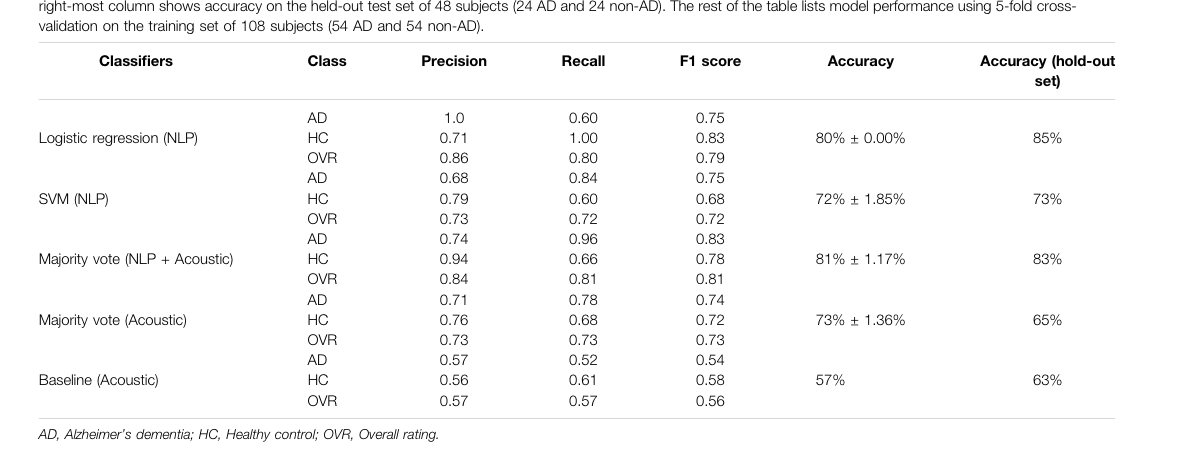
New Concepts
shoes and jackets
Last edited: August 8, 2025A friend recently asked for recommendations for shoes and jackets, and I realized that the links on my gear page has slowly died (very sad). So I figured I should update it with more information and alternatives.
What I (normatively) do
I’ll give specific recommendations shortly, but before I do that I feel like it’d be helpful to give some normative statements about what “good” gear to me feels like.
light, and waterproof, in that order
I try to get things that are both waterproof and light, and if both doesn’t exist (in particular for shoes), I prioritize being light.
short selling
Last edited: August 8, 2025Short selling involves betting against the stock.
Process of Short Selling
- the trader borrows a number of shares from a third party
- the trader sells them immediately for cash
- when the security dips, the debt is repaid by repurchasing the same amount of shares of the borrowed security at the lower price
- traders nets the profit from the negative price differential
If the person shorting
short squeeze
“what happened to GameStock”