turing machine
Last edited: August 8, 2025constituents
- \(Q\) is a finite set of states
- \(\Sigma\) is the input alphabet, where \(\square \not \in \Sigma\)
- \(\Gamma\) is the tape alphabet, where \(\square \in \Gamma\), and \(\Sigma \subseteq \Gamma\) (because we can write empty cells)
- \(\delta: Q \times \Gamma \to Q \times \Gamma \times \qty {L, R}\)
- \(q_0 \in Q\), the start state
- \(q_{a} \in Q\), the accept state
- \(q_{r} \neq q_{a}\in Q\), the reject state (because a Turing Machine may not terminate at end of input)
requirements
additional information
why TM is awesome
- a Turing Machine \(M = \qty(\Gamma, Q, S)\) should be ready for inputs of any length \(n\) (in particular, when designing \(M\), we don’t know what \(n\) will be)
- a Turing machine’s computation is “local”—you can’t look at the whole input, and the composition of these many local steps
- No ambiguity as to runtime: how many times you apply \(\delta\) before you get to Qaccept or Qreject
Church-Turing thesis as local steps
“computation is any process that takes place in a sequence of simple, local steps.”
turing machine (overview)
Last edited: August 8, 2025turing machine is a computational system that has a memory tape, and can go through the input multiple times; they don’t have to accept or reject states, turing machines can run forever and can have loops.
For the main topic, see turing machine
decidable vs. recognizable languages
- there are not enough Turing Machines to compute every language (so there are non-recognizable/non-decidable languages)
- halting problem and ATM, meaning strings where Turing Machines can’t decide them
- “the diagonalization argument”
- mapping reduction
- Rice’s Theorem
- strong reduction: higher achy of hard problems
self-reference
- turing Machines can view and produce its own code.
- foundations of mathematics can be shown using these systems
Kolomogorov Complexity
Two Statements About Uniformity
Last edited: August 8, 2025\(\text{BPP} \subseteq p / poly\)
Remember the advice-taking TM formulation of circuits.
Now, a language \(L \in \text{BPP}\) if \(\exists\) a polytime TM \(M\) such that:
- \(x \in L\) implies \(P\qty [M\qty(x, v) \text{ accepts}] \geq \frac{2}{3}\)
- \(x \not\in L\) implies \(P\qty [M\qty(x, v) \text{rejects}] \geq \frac{2}{3}\)
Intuition: we want to use \(r\) as advice. But, we need a “random” advice for each \(x\) which we don’t have. But; consider the following parameterization of BPP: we notice that if we have \(\frac{1}{3}\) chance of “bad” advice, we know that we can bump the failure down by trying a more, trending towards \(2^{-O\qty(k)}\). Using \(O\qty(k)\), by the union bound, we know at least one advice is good for all input \(x\).
two-dimensional heat equation
Last edited: August 8, 2025what if heat, but plate
\begin{equation} \pdv{u}{t} = \pdv[2]{u}{x} + \pdv[2]{u}{y} \end{equation}
For some heat distribution that has arbitrary shape, on some domain \(\Omega \times [0, \infty]_{t}\) (i.e. argumentation of some space dimensions by time).
- Dirichlet Conditions: edges have heat \(0\)
- OR Neumann Conditions: normal derivative (flux) is \(0\) at the edge
If \(\Omega\) is a general blob, you are actually kinda fucked. Because the bounds on \(x\) depend on \(y\), and \(y\) on \(x\), so you can’t just separate them into a product.
two's complement
Last edited: August 8, 2025Say we want to find the number which is the additive inverse (“negative”) of a number.
We can just flip each of the digit, and then add 1:
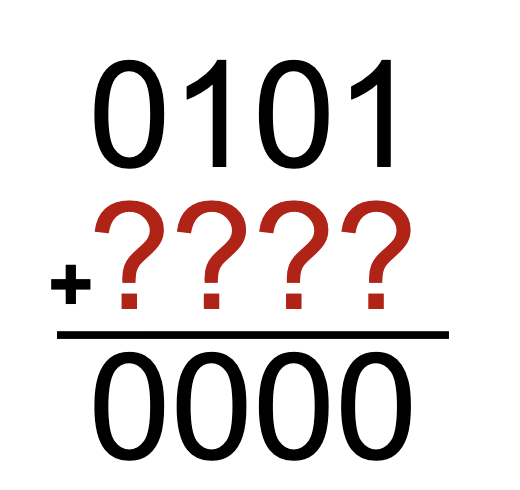
- take \(0101\), invert it to get \(1010\)
- adding these two numbers will give you \(1111\). If we just added one more \(0001\), it will flip over to be \(0000\).
- Therefore, \(1010+0001 = 1011\) is the additive inverse of \(0101\).
The left most bit being one: still a mark of whether or not something is negative. It just works backwards: