
MOEReview Gale: MegaBlocks
Last edited: December 12, 2025Standard MoEs either waste computation by padding unused capacity within each expert, or drop tokens assigned to an expert when it exceeds capacity (i.e. truncate so that we don’t have to pad too much).
Method
Instead of
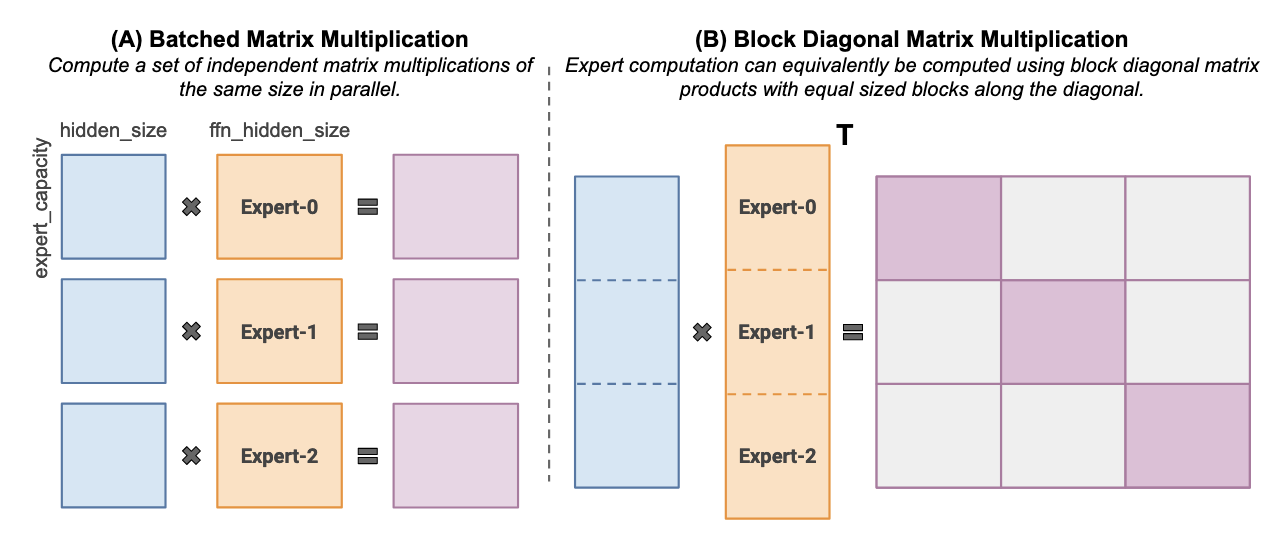
we do
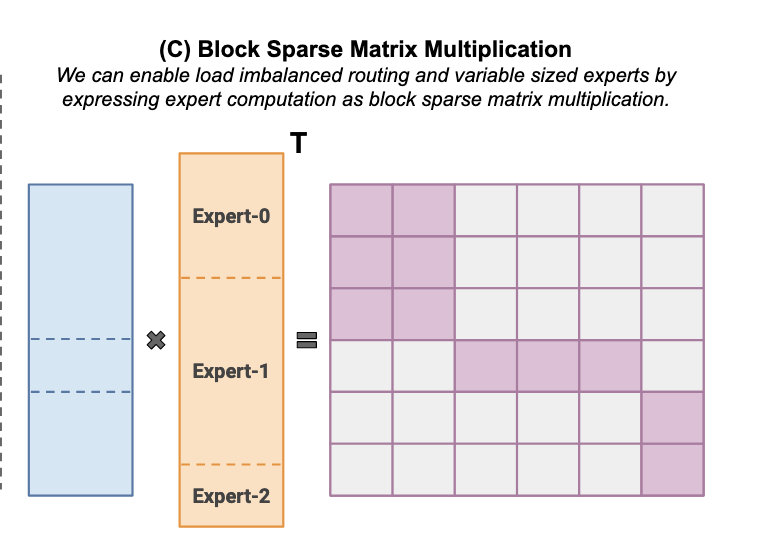
and leverage efficient block sparse multiplication to have variably-sized experts.
MOEReview Kaushik: Universal Subspace Hypothesis
Last edited: December 12, 2025One-Liner
There’s a low-rank “shared” universal subspace across many pretrained LMs, which could be thus leveraged to adapt a model to new tasks easier.
Notable Methods
Did a PCA, and projected variance from one architecture to others (i.e. LoRAs trained for different things).
MOEReview Krajewski: Scaling Laws for MoE
Last edited: December 12, 2025Define “granularity” as:
\begin{equation} G = \frac{d_{\text{ff}}}{d_{\text{expert}}} \end{equation}
at \(G=1\), we have a dense model; at \(G>1\), we have some kind of MoE.
Here are thy scaling laws:
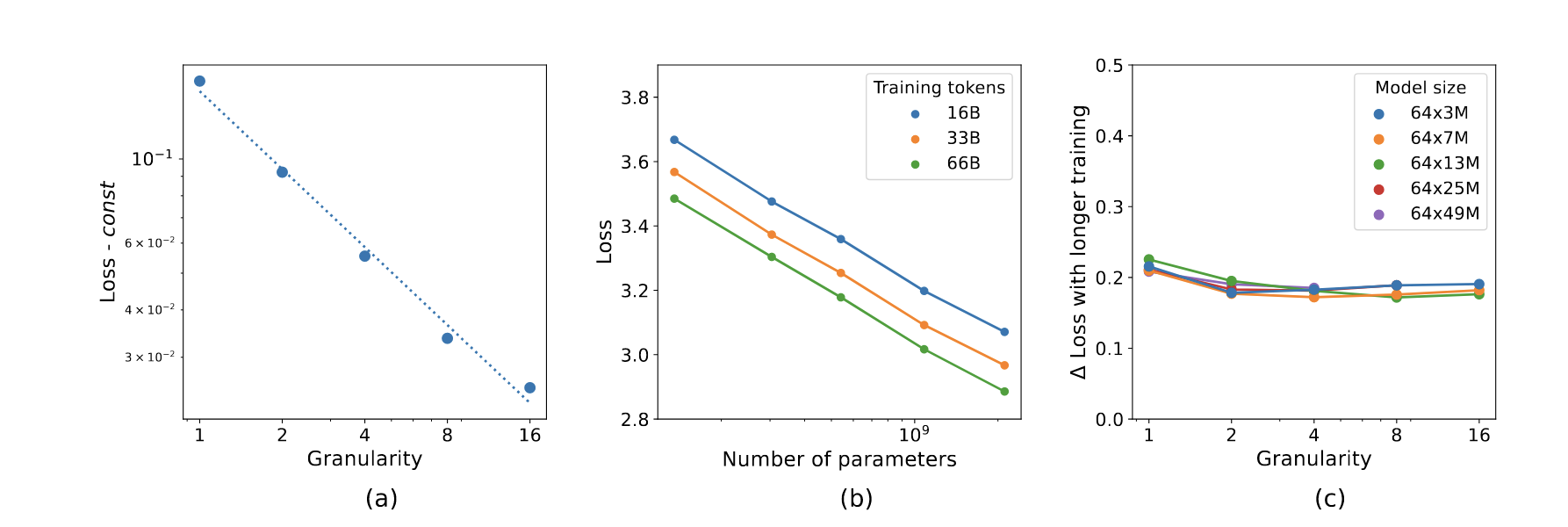
notice how its mostly linear! tiny experts yay!
MOEReview Li: Branch-Train-Merge
Last edited: December 12, 2025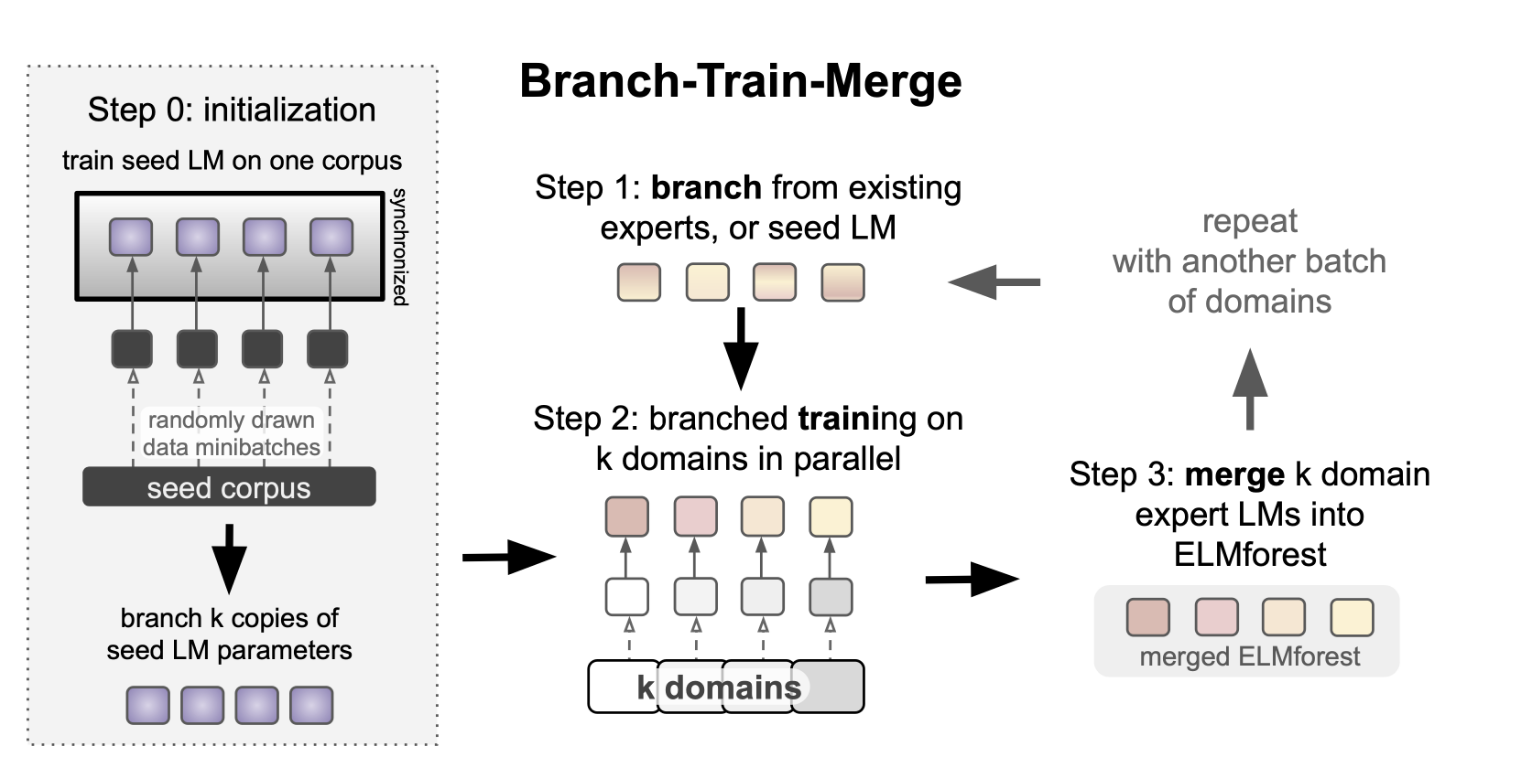
- weighted parameter average of the existing experts (or copy the new perts)
- training each expert independently
And then when inference we can use domain-conditioned averaging between the experts by computing:

or by averaging the parameters of the experts.
MOEReview Pan: Dense Training Sparse Inference
Last edited: December 12, 2025Train experts densely, and then during inference keep only topk