
Alivio April Checkin
Last edited: August 8, 2025- Want to interview more severe ashma
- Want to find someone younger
Difference between marketing and purchaser.
Taking to people
Spoke with Matt. Talked with more details with prototyping and how they can build a unique product.
Have not gotten back to him yet.
alpha vector
Last edited: August 8, 2025Recall, from conditional plan evaluation, we had that:
\begin{equation} U^{\pi}(b) = \sum_{s}^{} b(s) U^{\pi}(s) \end{equation}
let’s write it as:
\begin{equation} U^{\pi}(b) = \sum_{s}^{} b(s) U^{\pi}(s) = {\alpha_{\pi}}^{\top} b \end{equation}
where \(\U_{\pi}(s)\) is the conditional plan evaluation starting at each of the initial states.
\begin{equation} \alpha_{\pi} = \qty[ U^{\pi}(s_1), U^{\pi}(s_2) ] \end{equation}
You will notice, then the utility of \(b\) is linear on \(b\) for different policies \(\alpha_{\pi}\):
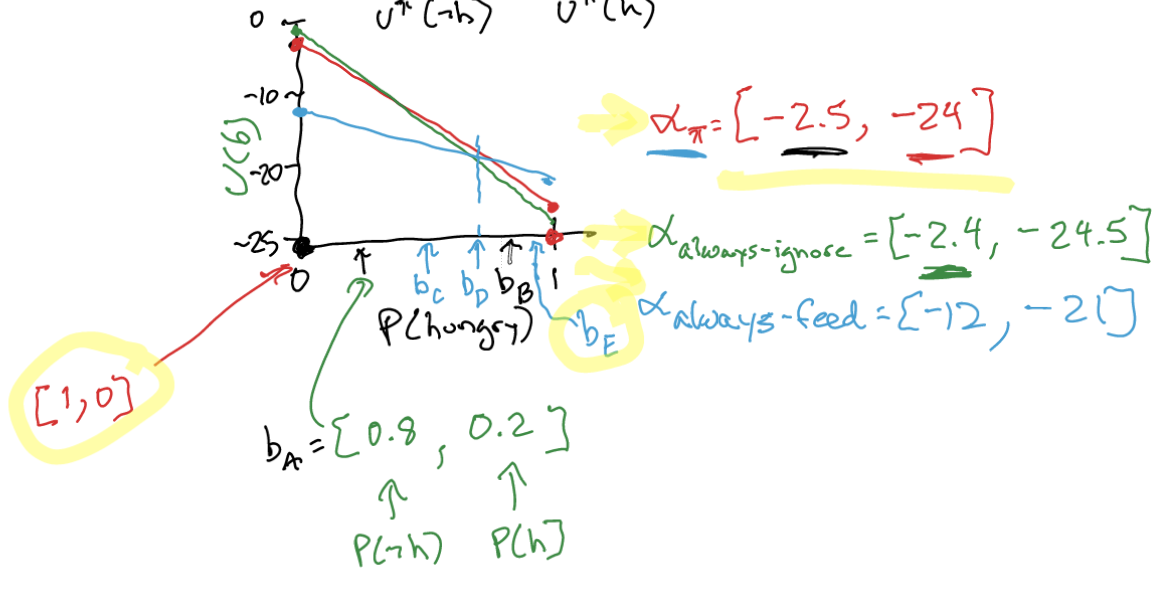
At every belief \(b\), there is a policy which has the highest \(U(b)\) at that \(b\) given be the alpha vector formulation.
alphabet
Last edited: August 8, 2025see also in programming string (C)
- an alphabet \(\Sigma\) is a finite set
- a finite-sequence of elements in \(\Sigma\) is called a string
- the set of all strings in \(\Sigma\) is called \(\Sigma^{*}\), which includes the empty string
- for a particular string \(x\), the length of it is \(|x|\)
- the string of length zero is called \(\varepsilon\)
- a language is a subset of \(\Sigma^{*}\), meaning its a set of strings
Omer seems to call strings “words” sometimes.
languages are boolean function over strings
For every language \(L\) over \(\Sigma\) corresponds to a unique function \(f: \Sigma^{*} \to \{0,1\}\), whereby if \(f(x) = 1\), then \(x \in L\); otherwise, if \(f(x) = 0\), \(x \not \in L\).
Alternating Least Squares
Last edited: August 8, 2025Alternating Least Squares is a method to Factoring a matrix into two components:
\begin{equation} \mathcal{M}( R) \approx \mathcal{M}(U) \cdot \mathcal{M}(P) \end{equation}
where, we want to come up matricies \(U\) and \(P\) with a certain side length \(k\) that we exdogenously come up with
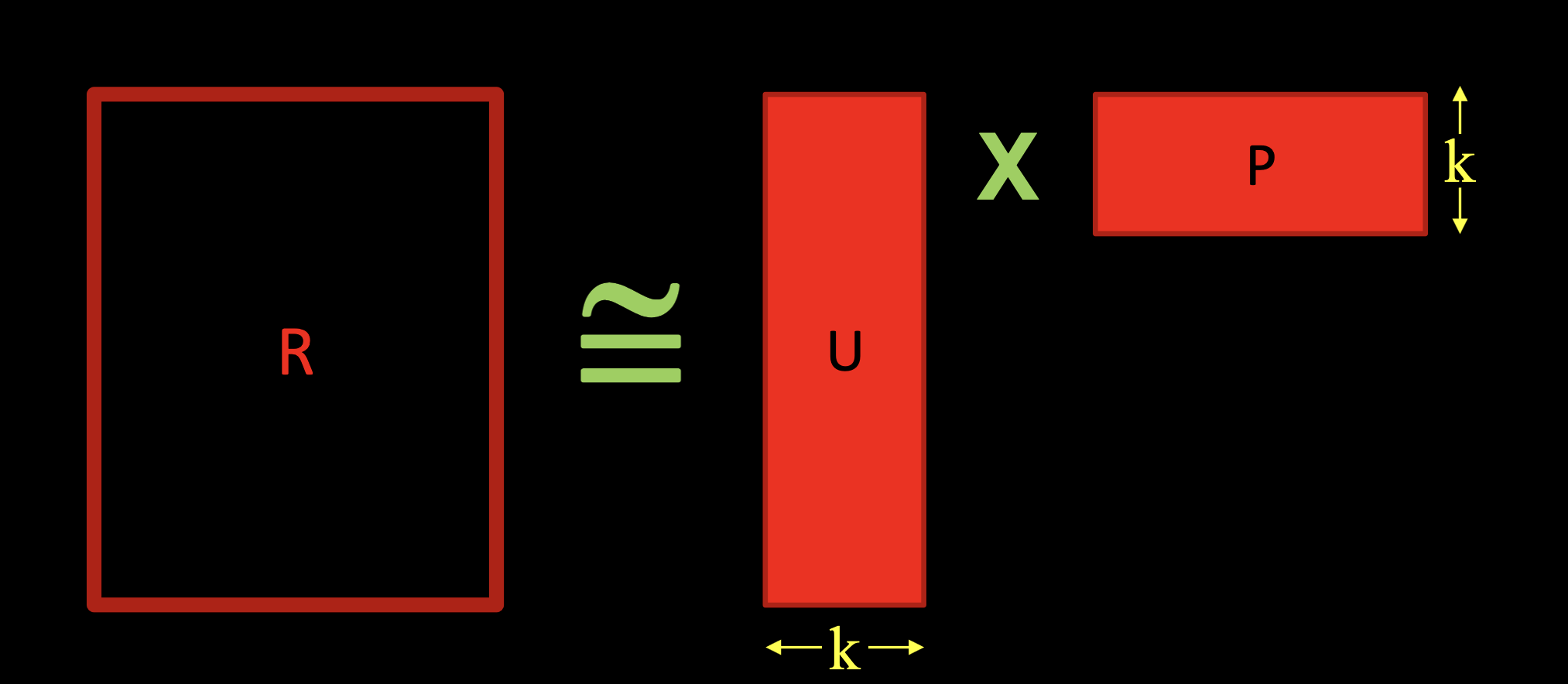
To perform Alternating Least Squares, we fix the values of either \(U\) or \(P\), then perform the least-squares optimization on
(This is proven best-fit for “non-pathological matricies”)
Ambulance Trajectories
Last edited: August 8, 2025Problem: current ambulance routing don’t optimize significantly on the contextual cases for stroke patients
Stroke hospitals: PSC is smaller than a CSC.
Previous work
Routing methods—
- route all patient to nearest PSC, which is worse than
- route high risk patient to CSC, which is worse than
- always route to CSC
This is counter-intuitive. How do we solve, given a stroke condition, available PSC/CSC locations, traffic, etc., for where and how to route a patient?