
AIBridgeLab D3Morning
Last edited: August 8, 2025Welcome to the Day-3 Morning Lab! We are glad for you to join us. Today, we are learning about how Pandas, a data manipulation tool, works, and working on cleaning some data of your own!
Iris Dataset
We are going to lead the Iris dataset from sklearn again. This time, however, we will load the full dataset and parse it ourselves (instead of using return_X_y.)
Let’s begin by importing the Iris dataset, as we expect.
AIBridgeLab D4Aft
Last edited: August 8, 2025Let’s run some clustering algorithms! We are still going to use the Iris data, because we are super familiar with it already. Loading it works the exactly in the same way; I will not repeat the notes but just copy the code and description from before here for your reference
Iris Dataset
Let’s load the Iris dataset! Begin by importing the load_iris tool from sklearn. This is an easy loader scheme for the iris dataset.
Air: A Greek Style Myth
Last edited: August 8, 2025I am honestly not entirely sure why or what state of mind I was in circa 2017 to write, edit, and act! in this video, but I did.
This is an adaption of a Greek-Style story which someone else wrote, I don’t know who.
Video produced mostly by myself in front of a green screen, with help from my lovely mother as well as a very nice teacher named Joseph O’Brian.
aircraft collision avoidance
Last edited: August 8, 2025suppose we have some aircraft, let’s consider a sensor on this aircraft which is measuring the altitude:
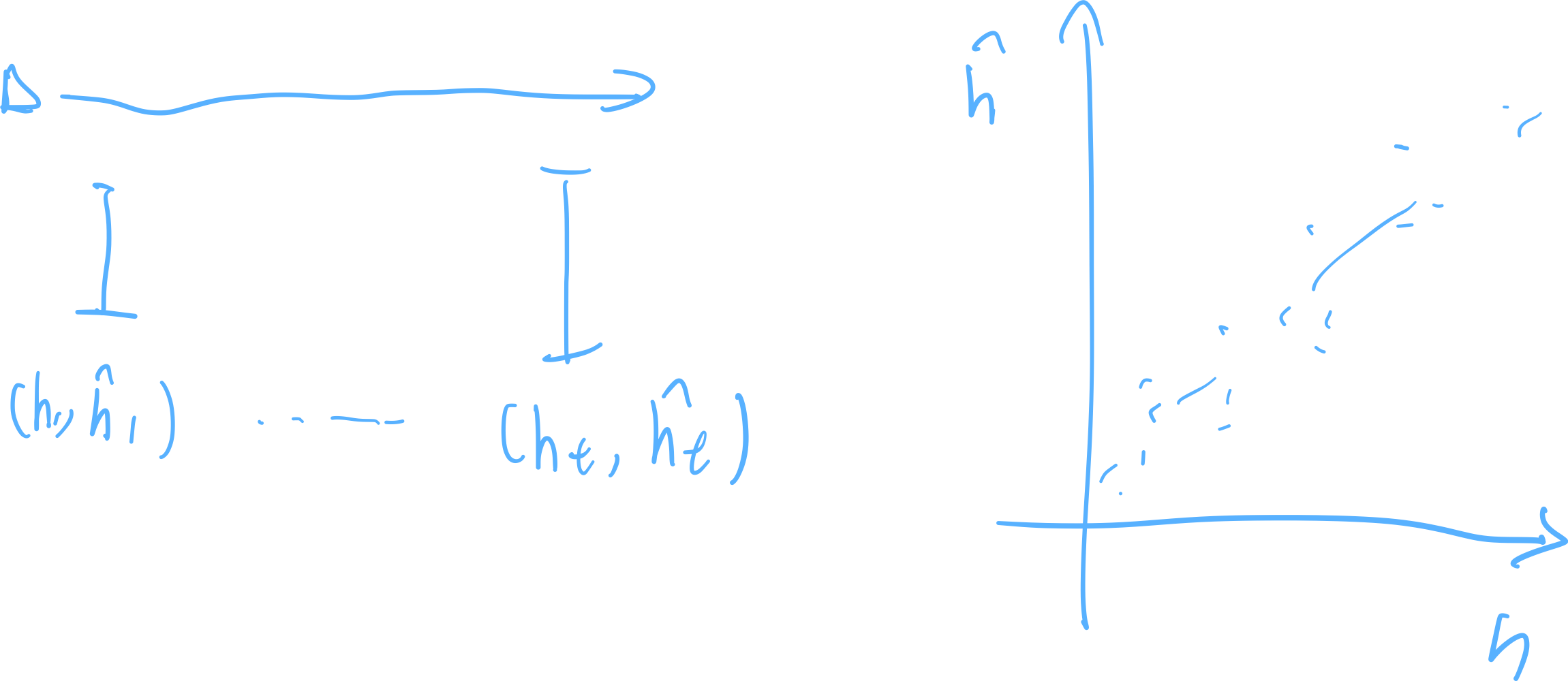
there’s a true altitude \(h_{t}\) that our system is at, and a measured altitude \(\hat{h}_{t}\), which has some relation.
We can make a observation model through a linear conditional Gaussian:
\begin{align} O \qty(o | s) &= O\qty(\hat{h} | h) \\ &= \mathcal{N}\qty(\hat{h} \mid f_{\theta}\qty(h), \sigma^{2}) \\ &= \mathcal{N}\qty(\hat{h} \mid \theta_{1} h + \theta_{2} \mid\sigma^{2}) \end{align}