
Alternating Least Squares
Last edited: August 8, 2025Alternating Least Squares is a method to Factoring a matrix into two components:
\begin{equation} \mathcal{M}( R) \approx \mathcal{M}(U) \cdot \mathcal{M}(P) \end{equation}
where, we want to come up matricies \(U\) and \(P\) with a certain side length \(k\) that we exdogenously come up with
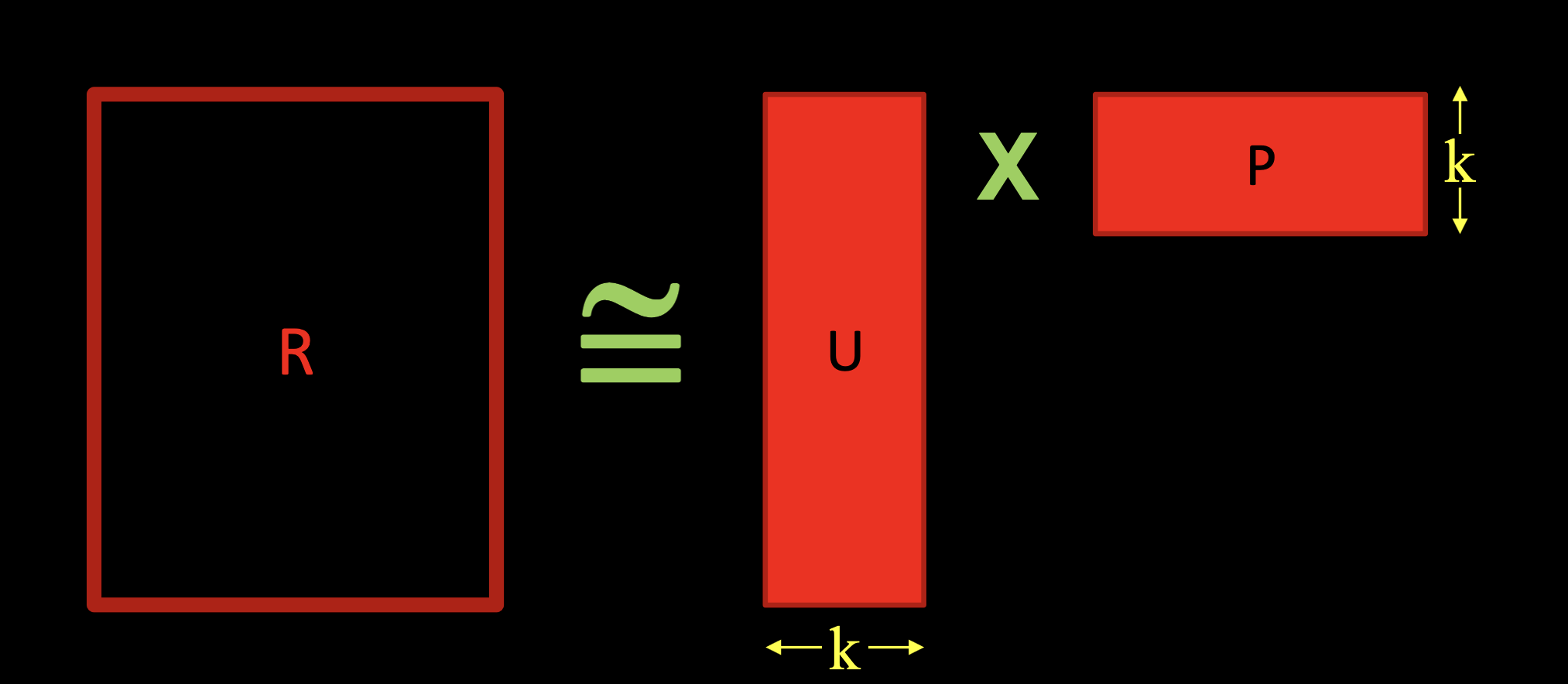
To perform Alternating Least Squares, we fix the values of either \(U\) or \(P\), then perform the least-squares optimization on
(This is proven best-fit for “non-pathological matricies”)
Ambulance Trajectories
Last edited: August 8, 2025Problem: current ambulance routing don’t optimize significantly on the contextual cases for stroke patients
Stroke hospitals: PSC is smaller than a CSC.
Previous work
Routing methods—
- route all patient to nearest PSC, which is worse than
- route high risk patient to CSC, which is worse than
- always route to CSC
This is counter-intuitive. How do we solve, given a stroke condition, available PSC/CSC locations, traffic, etc., for where and how to route a patient?
AML: Dipping into PyTorch
Last edited: August 8, 2025Hello! Welcome to the series of guided code-along labs to introduce you to the basis of using the PyTorch library and its friends to create a neural network! We will dive deeply into Torch, focusing on how practically it can be used to build Neural Networks, as well as taking sideroads into how it works under the hood.
Getting Started
To get started, let’s open a colab and import Torch!
import torch
import torch.nn as nn
The top line here import PyTorch generally, and the bottom line imports the Neural Network libraries. We will need both for today and into the future!
AML: Iris Strikes Back
Last edited: August 8, 2025You are no doubt familiar with the Iris dataset: a dataset containing flower pedal shapes and their corresponding sub-type of Iris flower: Setosa, Versicolour, and Virginica.
We are going to take those pedal measurements, and predict the type of Iris we are looking at!
Let’s get the Iris dataset first. Turns out, Scikit Learn (your old friend from last semester) ships a copy of the Iris dataset with itself. So, we will load the dataset from it.
AML: Your First Article
Last edited: August 8, 2025Hello y’all! This quick post about… writing your first “article” (ahem, MA) for this class. To me, the most rewarding part of our journey together is to be able to support everyone through writing very presentable reports—even if it is on old or simple problems—but in the format from which you can easily jump off and write a fully-blown scientific article in the future.